Search This Blog
Monday, August 05, 2019
Wednesday, December 05, 2018
Now I know it`s supposed to be all about `exploring new innovations in the visual arts` - that kind of thing - but once again the reputation of visual art has been invaded by yet more meaningless nonsense. Given that the award is supposed to honour the name of JMW Turner I`m sure that, now as an annual ritual, he is once again turning in his grave.
Now, Turner was himself supposed to have been controversial in his time but at least he produced pictures that people could recognise and admire. These days it seems the whole idea of what constitutes visual art is reduced to parody, to farce and, yes, to pantomime. Kim Howells got it right when, as Culture Minister in 2002, he pinned this message on a board specially designated for visitors` comments:-
"If this is the best British artists can produce then British art is lost. It is cold, mechanical, conceptual bullshit." PS : "The attempts at conceptualisation are particularly pathetic and symptomatic of a lack of conviction."
Anyway, just to remind us of the heights to which visual art should, even today, aspire, have a look at this and be thankful that Jan van Eyck didn`t have a mobile phone:-
Sunday, September 30, 2018
Sunday, September 20, 2015
He will be missed.
Sunday, August 24, 2014
Tuesday, November 06, 2012
The first one which was revealed (pictured above) bore little resemblance to the Ted Bates we all knew and admired. Instead, it turned out to be a very fair representation of Jimmy Krankie and thus attracted some well deserved ridicule. So a second one (pictured left) was commissioned and does Ted Bates well, standing outside the main entrance to St. Mary`a Stadium. So I hope Manchester United don`t suffer the same problems but then there really is only one image that captures the restraint and dignity of the knight of the realm that is Ferguson and on which the statue must surely be based. It`s this one:-
Monday, May 28, 2012
The Director of the Turner Contemporary, one Victoria Pomery, said that most of the work had been produced by Emin in the last eight months and was completely unseen. So, now we know. Most of the stuff on show has been knocked up in quick time and if the example shown above is anything to go by, I`m not surprised and it shows. Where`s a three year old when you need one?
Of course, the art luvvies will love it, as it is a prime example of a load of complete tat masquerading as something deeply meaningful and will thus doubtless fetch a good price among those with more money than sense. It`s just the latest in a career that has seen Emin produce endless streams of rubbish by which she has amassed an indecent fortune and a reputation as a `character,` a `personality,` even a `celebrity.` And all achieved with a charmless persona which of itself could do well in the Turner Prize, for which Emin was astonishingly nominated some time ago.
And now to add insult to injury we learn that Emin is to carry the Olympic Torch through the streets of her beloved Margate, presumably on the basis that she might be the town`s best known product. Although, in fairness, there is something artistic, almost touching, in the twin imitations of Emin, with her modest skills, and The Torch, with its trumpeted pointlessness, coming together in what must surely be the last resort on the Kent coast.
Monday, August 22, 2011
I was sorry to learn that Prime Minister David Cameron thought it necessary to cut short his holiday in Cornwall and return to Downing Street. We`re told that he did so in order to chair a meeting to discuss the present situation in Libya. Whilst that sounds plausible, I suspect that he was more anxious to be seen taking whatever credit he can for Britain`s part in the toppling of Gadaffi, rather than staying in Cornwall and letting his Deputy Nick Clegg hog the limelight.
But, once a PR man, always a PR man I guess. I have to be honest and say that if I were in Cameron`s shoes (Heaven forbid) wild horses would never drag me away from Trebetherick simply to have a pose in front of the cameras. And in any case, I would most definitely think twice about entering No. 10 now that the frightful Tracey Emin has responded to Cameron`s request for one of her `works` to become part of the Government Art Collection.
But what is really alarming is that Emin`s `work` has an estimated value of £250,000, which instantly recalls one of Harry Enfield`s sketches whereby dimwitted airhead young ladies enter his affected bijou shop and quite happily buy bits of rubbish for exhorbitant prices. But at least I have now discovered that there is a `Government Art Collection,` which I take to mean that it`s ours really as the collection, including Emin`s pretensious mediocrity, has been built up using taxpayers` money. I`m surprised there wasn`t a consultation period or even a referendum to decide whether we really wanted to be saddled with such tosh.
It all reminds me of Christmas, as for years now I have long suspected that the Christmas cards sent out from the Prime Minister, Government Departments, Quangos, Councils and the rest of the public sector panoply are all paid for by us taxpayers too. In which case, it`s about time I received one.
Friday, May 06, 2011
Tuesday, December 07, 2010
But, I have been heartened by the discovery of the alternative Turner Prize - the Turnip Prize - which is held annually in the Somerset village of Wedmore. This year`s Turnip Prize has gone to Doug Pitt who produced a plate depicting the Chilli `n` minors - a big chilli with some smaller ones - and as daft as it sounds, this winning entry and the whole concept of the alternative prize turns out to be more meaningful, more legitimate and much more enjoyable than anything that goes on in Tate Modern. In the name of reason, common sense and the rejection of artistic pretension, have a look at:-
http://www.thisisthewestcountry.co.uk/news/8723166.The_Turnip_Prize__The_results_are_in/
....and a history of the Turnips and a list of past entrants can be found at http://en.wikipedia.org/wiki/Turnip_Prize
Thursday, October 07, 2010

Thursday, September 18, 2008
Tuesday, September 16, 2008

I don`t like `modern art.` I quite admire the experimental nature of some of it and the statements made by Hirst, Emin, Whitehorn and the rest. But to pretend they represent real art doesn`t wash with me. A lot of it is pretentious, ugly, temporary and overpriced.
Now here, in my humble opinion, is what `modern art` should look like:-
Monday, September 10, 2007
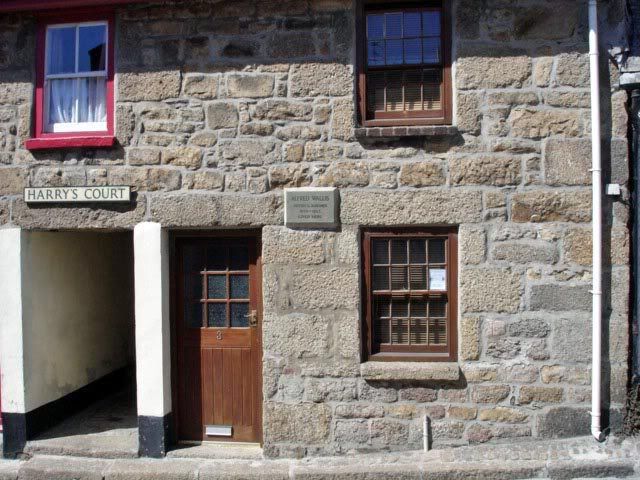
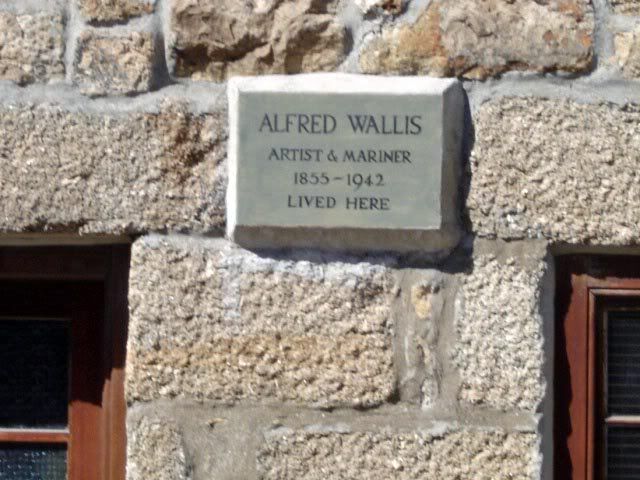
However, the visit was enriched by the discovery of a rather small, inconspicuous terraced cottage, bearing a plaque.
I always find plaques intriguing and I can`t resist checking them out and, on this occasion, I was not to be disappointed, for it turned out to be the cottage where Alfred Wallis had lived.
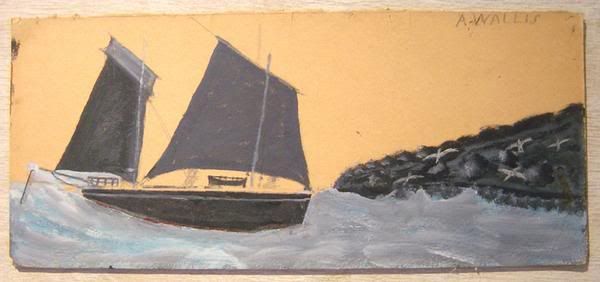
Wallis was born in Devonport on 18 August 1855. Living from childhood along the south-western coast of England, he started life as a fisherman at sea from the young age of nine. It was only on retirement from the sea, around 1925, that Wallis began to paint. His chosen subject matter reflected his profession and surroundings and was limited to views of shipping and the sea. Wallis's poverty prompted him to work on whatever materials came to hand, including driftwood and cardboard
(This one - `Sailing off St. Ives` - is in oil on card laid on board: click to enlarge)
Wallis's complete lack of formal training meant that his vision remained fresh and untainted by traditional preconceptions of 'correct' draughtsmanship and perspective. This quality of immediacy and truth aroused the interest of progressive artists, in particular Ben Nicholson (1894–1982) and Christopher Wood (1901–30), both being members of the artistic colony who chose to work in the crisp light of St Ives. Despite recognition and admiration from artistic circles, Wallis's work did not capture the public's imagination during his lifetime and he died in poverty in Madron Workhouse near Penzance on 29 August 1942.
Since then, of course, his works are considered to be priceless....oh, yes, and his cottage can be rented for holidays (at the right price, I imagine.)Saturday, July 14, 2007
There have been very few occasions when I have genuinely been awestruck . Seeing the interior of St. Paul`s and Winchester Cathedrals are two examples but the world of the visual arts provided another.
A few years ago, on an impulsive Sunday morning, my eldest son, David and I visitied the National Gallery in London for the first time. It`s a wondeful place - all the usual suspects are there to be seen, the great and the good throughout the history of visual art. But however long you might reel off the familiar names, it`s a matter of some doubt that you will utter the name of Joseph Wright of Derby.
Now, the National Gallery has countless `rooms` and on a Sunday morning they all tend to be well populated, people going round them in an orderly fashion, seldom forming what you might call a crowd around any particular exhibit. Until, that it, you come to `An Experiment on a bird in the Air Pump.` On the Sunday morning of our visit, we went into the room and there were the people crowded round this quite stunning work. It is Joseph Wright`s crowning masterpiece - and it`s huge, 183 x 244cm - and it shows a travelling scientist demonstrating the formation of a vacuum by the withdrawal of air from a flask containing a white cockatoo.
The point of the painting is not so much to demontrate the science but more to show the human emotion which the experiment brings to the onlookers. The little girl is worried whether the bird will die - Wright leaves the question unanswered; the young lovers on the left seem only to be concerned about themselves. The painting also demonstrates Wright`s mastery of light - the whole scene is lit by the one candle on the table. There is so much to admire, so much to contemplate - small wonder the Sunday morning crowd were as much in awe as I was.
Years ago, the BBC produced a groundbreaking series by the then Sir Kenneth (later Lord) Clark - `Civilisation` which tracked the growth of civilisation as seen through the arts, music and architecture of the ages. In it he dismisses Wright as `a mediocrity.` If the visual arts are about anything, they are about lifting the spirit, which Wright`s painting surely did on that Sunday morning. Much as I admired Lord Clark`s intellect, I fear he has misjudged one of the finest artists of the 18th century by his uncivilised comment.
More information can be found at http://www.nationalgallery.org.uk/cgi-bin/WebObjects.dll/CollectionPublisher.woa/wa/work?workNumber=ng725)